Skip to content

Bài 46: Heavy-Light Decomposition - Phân rã cây!

Tác giả: FPTOJ Team
Nội dung tham khảo từ: VNOI Wiki, CP-Algorithms


Bạn sẽ học được gì?

  • Heavy/Light edges là gì và tại sao chỉ có \(O(\log N)\) light edges trên đường đi
  • HLD biến đường đi trên cây thành \(O(\log N)\) đoạn liên tục
  • Truy vấn min/max/sum trên đường đi trong \(O(\log^2 N)\)
  • Cách áp dụng HLD cho truy vấn subtree, LCA, và cập nhật cạnh

Bản chất vấn đề

Phát biểu

Cho cây \(N\) đỉnh (\(N \leq 10^5\)), mỗi đỉnh có một giá trị. Hỗ trợ hai loại truy vấn:

Loại truy vấn Mô tả
UPDATE(u, val) Gán giá trị val cho đỉnh \(u\)
QUERY(u, v) Tìm tổng / min / max trên đường đi từ \(u\) đến \(v\)

Tại sao bài toán khó?

Với mỗi truy vấn QUERY(u, v), ta cần duyệt toàn bộ đường đi từ \(u\) lên LCA rồi xuống \(v\). Cách naïve mất \(O(N)\) mỗi truy vấn, \(Q\) truy vấn sẽ là \(O(N \cdot Q)\) — quá chậm với \(N, Q = 10^5\).

Đường đi trên cây không phải là một đoạn liên tục trong mảng, nên không thể dùng Segment Tree trực tiếp.

Giải pháp

Dùng Heavy-Light Decomposition (HLD) để biến đường đi trên cây thành \(O(\log N)\) đoạn liên tục trong mảng, rồi dùng Segment Tree trên mỗi đoạn.


Tư duy cốt lõi

Heavy Edge và Light Edge

Với mỗi đỉnh \(u\) (không phải lá), gọi \(sz[v]\) là kích thước cây con gốc \(v\).

  • Heavy edge của \(u\): cạnh nối \(u\) với con \(v\)\(sz[v]\) lớn nhất (nếu nhiều con cùng kích thước, chọn bất kỳ).
  • Light edge của \(u\): tất cả các cạnh còn lại từ \(u\) đến các con.
graph TD A["1 (sz=10)"] -->|"heavy, sz=7"| B["3"] A -->|"light, sz=4"| C["2"] B --> D["6"] B --> E["7"] C --> F["4"] C --> G["5"] G --> H["8"] linkStyle 0 stroke:#ff0000,stroke-width:3px linkStyle 1 stroke:#0000ff,stroke-width:1px,stroke-dasharray:5

Cạnh \((1, 3)\) là heavy edge vì \(sz[3] = 7 > sz[2] = 4\).

Tính chất cốt lõi: Light edges giảm một nửa kích thước

Định lý

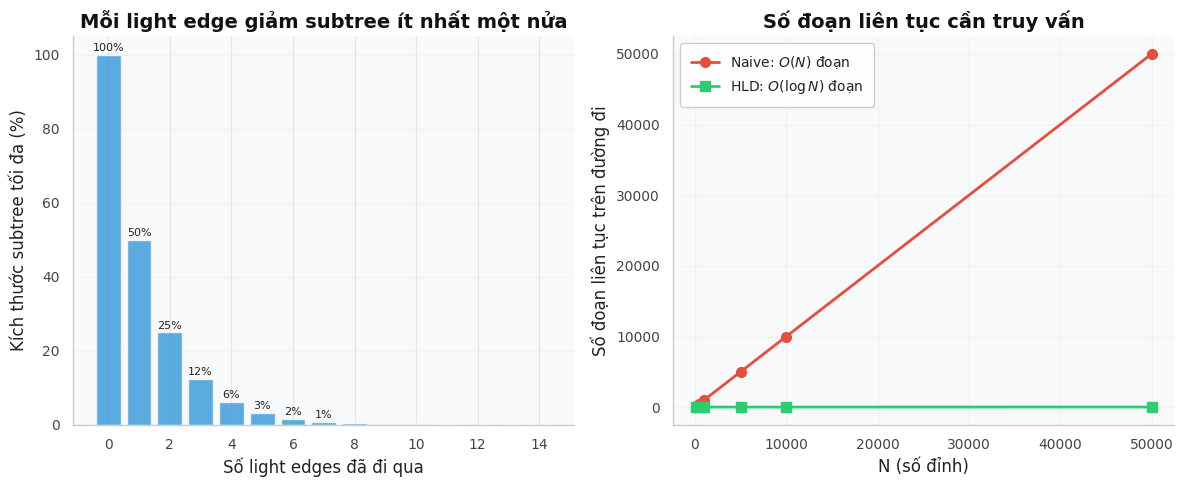
Trên đường đi từ gốc đến bất kỳ lá, có tối đa \(\log N\) light edges.

Chứng minh: Khi đi qua một light edge từ \(u\) sang con \(v\), ta có \(sz[v] \leq sz[u]/2\) (vì \(v\) không phải heavy child). Vậy kích thước cây con giảm ít nhất một nửa. Sau tối đa \(\log N\) bước, kích thước giảm xuống 1.

Đây chính là "bí mật" khiến HLD hoạt động hiệu quả: mỗi lần nhảy qua light edge, cây con co lại ít nhất một nửa.

Chain Decomposition - Phân rã chuỗi

Mỗi heavy path (chuỗi các heavy edges liên tiếp) tạo thành một chain. Ta gán DFS order (thứ tự duyệt) sao cho mỗi chain là một đoạn liên tục trong mảng.

graph TD subgraph "Cây gốc" A1["1"] -->|"heavy"| A2["2"] A1 -->|"light"| A3["3"] A2 -->|"heavy"| A4["4"] A2 -->|"light"| A5["5"] A3 -->|"heavy"| A6["6"] A4 -->|"heavy"| A7["7"] end subgraph "Chain 1: pos 1-4" B1["pos=1"] --- B2["pos=2"] --- B3["pos=3"] --- B4["pos=4"] end subgraph "Chain 2: pos 5-6" B5["pos=5"] --- B6["pos=6"] end subgraph "Chain 3: pos 7" B7["pos=7"] end

Mỗi chain ứng với một đoạn liên tục trong mảng, nên có thể dùng Segment Tree trên toàn bộ mảng.

Các biến cần lưu trữ

Biến Ý nghĩa
\(pos[u]\) Vị trí của đỉnh \(u\) trong mảng (theo DFS order)
\(head[u]\) Đỉnh đầu tiên trong chain chứa \(u\)
\(heavy[u]\) Con nặng (heavy child) của \(u\), \(-1\) nếu là lá
\(parent[u]\) Cha của \(u\)
\(depth[u]\) Độ sâu của \(u\)
\(sz[u]\) Kích thước cây con gốc \(u\)

Bước 1: DFS tìm Heavy Child

DFS tính \(parent\), \(depth\), \(sz\), \(heavy\) cho mỗi đỉnh.

#include <bits/stdc++.h>
using namespace std;

const int MAXN = 100005;

int n;
vector<int> adj[MAXN];
int parent[MAXN], depth[MAXN], sz[MAXN], heavy[MAXN];

void dfs(int u, int p) {
    parent[u] = p;
    sz[u] = 1;
    heavy[u] = -1;
    int max_sz = 0;

    for (int v : adj[u]) {
        if (v == p) continue;
        depth[v] = depth[u] + 1;
        dfs(v, u);
        sz[u] += sz[v];
        if (sz[v] > max_sz) {
            max_sz = sz[v];
            heavy[u] = v;
        }
    }
}
import sys
from collections import defaultdict

sys.setrecursionlimit(300000)

n = 0
adj = defaultdict(list)
parent = [0] * 200005
depth = [0] * 200005
sz = [0] * 200005
heavy = [-1] * 200005

def dfs(u, p):
    parent[u] = p
    sz[u] = 1
    heavy[u] = -1
    max_sz = 0

    for v in adj[u]:
        if v == p:
            continue
        depth[v] = depth[u] + 1
        dfs(v, u)
        sz[u] += sz[v]
        if sz[v] > max_sz:
            max_sz = sz[v]
            heavy[u] = v

Bước 2: Decompose - Gán DFS Order

Thứ tự thăm đỉnh rất quan trọng: gốc, heavy child, heavy child của heavy child, rồi quay lại light children. Nhờ vậy, toàn bộ heavy path được gán liên tục trong mảng \(pos[]\).

int cur_pos;
int head[MAXN], pos[MAXN];
int val[MAXN], arr[MAXN];

void decompose(int u, int h) {
    head[u] = h;
    pos[u] = cur_pos;
    arr[cur_pos] = val[u];
    cur_pos++;

    if (heavy[u] != -1) {
        decompose(heavy[u], h);
    }

    for (int v : adj[u]) {
        if (v == parent[u] || v == heavy[u]) continue;
        decompose(v, v);
    }
}

// Gọi trong main:
// dfs(1, -1);
// decompose(1, 1);
cur_pos = 0
head = [0] * 200005
pos_arr = [0] * 200005
val = [0] * 200005
seg_arr = [0] * 200005

def decompose(u, h):
    global cur_pos
    head[u] = h
    pos_arr[u] = cur_pos
    seg_arr[cur_pos] = val[u]
    cur_pos += 1

    if heavy[u] != -1:
        decompose(heavy[u], h)

    for v in adj[u]:
        if v == parent[u] or v == heavy[u]:
            continue
        decompose(v, v)

# Gọi:
# dfs(1, -1)
# decompose(1, 1)

Bước 3: Segment Tree trên mảng

Sau khi decompose, ta có mảng arr[] phẳng. Dùng Segment Tree để truy vấn / cập nhật trên mảng này.

struct SegTree {
    int n;
    vector<long long> tree;

    void init(int _n) {
        n = _n;
        tree.assign(4 * n, 0);
    }

    void build(int node, int tl, int tr, long long a[]) {
        if (tl == tr) {
            tree[node] = a[tl];
            return;
        }
        int tm = (tl + tr) / 2;
        build(2 * node, tl, tm, a);
        build(2 * node + 1, tm + 1, tr, a);
        tree[node] = tree[2 * node] + tree[2 * node + 1];
    }

    void update(int node, int tl, int tr, int pos, long long val) {
        if (tl == tr) {
            tree[node] = val;
            return;
        }
        int tm = (tl + tr) / 2;
        if (pos <= tm)
            update(2 * node, tl, tm, pos, val);
        else
            update(2 * node + 1, tm + 1, tr, pos, val);
        tree[node] = tree[2 * node] + tree[2 * node + 1];
    }

    long long query(int node, int tl, int tr, int l, int r) {
        if (l > tr || r < tl) return 0;
        if (l <= tl && tr <= r) return tree[node];
        int tm = (tl + tr) / 2;
        return query(2 * node, tl, tm, l, r) +
               query(2 * node + 1, tm + 1, tr, l, r);
    }
};
class SegTree:
    def __init__(self, n):
        self.n = n
        self.tree = [0] * (4 * n)

    def build(self, node, tl, tr, arr):
        if tl == tr:
            self.tree[node] = arr[tl]
            return
        tm = (tl + tr) // 2
        self.build(2 * node, tl, tm, arr)
        self.build(2 * node + 1, tm + 1, tr, arr)
        self.tree[node] = self.tree[2 * node] + self.tree[2 * node + 1]

    def update(self, node, tl, tr, pos, val):
        if tl == tr:
            self.tree[node] = val
            return
        tm = (tl + tr) // 2
        if pos <= tm:
            self.update(2 * node, tl, tm, pos, val)
        else:
            self.update(2 * node + 1, tm + 1, tr, pos, val)
        self.tree[node] = self.tree[2 * node] + self.tree[2 * node + 1]

    def query(self, node, tl, tr, l, r):
        if l > tr or r < tl:
            return 0
        if l <= tl and tr <= r:
            return self.tree[node]
        tm = (tl + tr) // 2
        return (self.query(2 * node, tl, tm, l, r) +
                self.query(2 * node + 1, tm + 1, tr, l, r))

Bước 4: Path Query - Truy vấn đường đi

Để truy vấn đường đi từ \(u\) đến \(v\):

  1. Miễn là \(head[u] \neq head[v]\), nhảy lên chain chứa đỉnh sâu hơn.
  2. Khi \(head[u] = head[v]\), truy vấn đoạn còn lại giữa \(u\)\(v\).

Mỗi bước nhảy qua một light edge, tối đa \(O(\log N)\) bước.

SegTree st;

long long path_query(int u, int v) {
    long long res = 0;
    while (head[u] != head[v]) {
        if (depth[head[u]] > depth[head[v]]) swap(u, v);
        res += st.query(1, 0, n - 1, pos[head[v]], pos[v]);
        v = parent[head[v]];
    }
    if (depth[u] > depth[v]) swap(u, v);
    res += st.query(1, 0, n - 1, pos[u], pos[v]);
    return res;
}

void update_node(int u, long long val) {
    st.update(1, 0, n - 1, pos[u], val);
}
st = SegTree(n)

def path_query(u, v):
    res = 0
    while head[u] != head[v]:
        if depth[head[u]] > depth[head[v]]:
            u, v = v, u
        res += st.query(1, 0, n - 1, pos_arr[head[v]], pos_arr[v])
        v = parent[head[v]]
    if depth[u] > depth[v]:
        u, v = v, u
    res += st.query(1, 0, n - 1, pos_arr[u], pos_arr[v])
    return res

def update_node(u, val):
    st.update(1, 0, n - 1, pos_arr[u], val)

Code đầy đủ (Full Solution)

#include <bits/stdc++.h>
using namespace std;

const int MAXN = 100005;

int n;
vector<int> adj[MAXN];
int parent[MAXN], depth[MAXN], sz[MAXN], heavy[MAXN];
int head[MAXN], pos[MAXN];
int cur_pos;
long long val[MAXN], arr[MAXN];

void dfs(int u, int p) {
    parent[u] = p;
    sz[u] = 1;
    heavy[u] = -1;
    int max_sz = 0;
    for (int v : adj[u]) {
        if (v == p) continue;
        depth[v] = depth[u] + 1;
        dfs(v, u);
        sz[u] += sz[v];
        if (sz[v] > max_sz) {
            max_sz = sz[v];
            heavy[u] = v;
        }
    }
}

void decompose(int u, int h) {
    head[u] = h;
    pos[u] = cur_pos;
    arr[cur_pos] = val[u];
    cur_pos++;
    if (heavy[u] != -1) {
        decompose(heavy[u], h);
    }
    for (int v : adj[u]) {
        if (v == parent[u] || v == heavy[u]) continue;
        decompose(v, v);
    }
}

struct SegTree {
    int n;
    vector<long long> tree;
    void init(int _n) { n = _n; tree.assign(4 * n, 0); }
    void build(int nd, int tl, int tr, long long a[]) {
        if (tl == tr) { tree[nd] = a[tl]; return; }
        int tm = (tl + tr) / 2;
        build(2*nd, tl, tm, a); build(2*nd+1, tm+1, tr, a);
        tree[nd] = tree[2*nd] + tree[2*nd+1];
    }
    void update(int nd, int tl, int tr, int p, long long v) {
        if (tl == tr) { tree[nd] = v; return; }
        int tm = (tl + tr) / 2;
        if (p <= tm) update(2*nd, tl, tm, p, v);
        else update(2*nd+1, tm+1, tr, p, v);
        tree[nd] = tree[2*nd] + tree[2*nd+1];
    }
    long long query(int nd, int tl, int tr, int l, int r) {
        if (l > tr || r < tl) return 0;
        if (l <= tl && tr <= r) return tree[nd];
        int tm = (tl + tr) / 2;
        return query(2*nd, tl, tm, l, r) + query(2*nd+1, tm+1, tr, l, r);
    }
} st;

long long path_query(int u, int v) {
    long long res = 0;
    while (head[u] != head[v]) {
        if (depth[head[u]] > depth[head[v]]) swap(u, v);
        res += st.query(1, 0, n-1, pos[head[v]], pos[v]);
        v = parent[head[v]];
    }
    if (depth[u] > depth[v]) swap(u, v);
    res += st.query(1, 0, n-1, pos[u], pos[v]);
    return res;
}

void update_node(int u, long long v) {
    st.update(1, 0, n-1, pos[u], v);
}

int main() {
    ios::sync_with_stdio(false);
    cin.tie(nullptr);

    int q;
    cin >> n >> q;
    for (int i = 1; i <= n; i++) cin >> val[i];
    for (int i = 0; i < n - 1; i++) {
        int u, v;
        cin >> u >> v;
        adj[u].push_back(v);
        adj[v].push_back(u);
    }

    dfs(1, -1);
    cur_pos = 0;
    decompose(1, 1);

    st.init(n);
    st.build(1, 0, n-1, arr);

    while (q--) {
        int type;
        cin >> type;
        if (type == 1) {
            int u; long long v;
            cin >> u >> v;
            update_node(u, v);
        } else {
            int u, v;
            cin >> u >> v;
            cout << path_query(u, v) << '\n';
        }
    }
    return 0;
}
import sys
from collections import defaultdict

sys.setrecursionlimit(300000)
input = sys.stdin.readline

n = 0
adj = defaultdict(list)
parent = [0] * 200005
depth = [0] * 200005
sz = [0] * 200005
heavy = [-1] * 200005
head = [0] * 200005
pos_arr = [0] * 200005
val = [0] * 200005
seg_arr = [0] * 200005
cur_pos = 0

def dfs(u, p):
    parent[u] = p
    sz[u] = 1
    heavy[u] = -1
    max_sz = 0
    for v in adj[u]:
        if v == p:
            continue
        depth[v] = depth[u] + 1
        dfs(v, u)
        sz[u] += sz[v]
        if sz[v] > max_sz:
            max_sz = sz[v]
            heavy[u] = v

def decompose(u, h):
    global cur_pos
    head[u] = h
    pos_arr[u] = cur_pos
    seg_arr[cur_pos] = val[u]
    cur_pos += 1
    if heavy[u] != -1:
        decompose(heavy[u], h)
    for v in adj[u]:
        if v == parent[u] or v == heavy[u]:
            continue
        decompose(v, v)

class SegTree:
    def __init__(self, n):
        self.n = n
        self.tree = [0] * (4 * n)
    def build(self, nd, tl, tr, arr):
        if tl == tr:
            self.tree[nd] = arr[tl]
            return
        tm = (tl + tr) // 2
        self.build(2*nd, tl, tm, arr)
        self.build(2*nd+1, tm+1, tr, arr)
        self.tree[nd] = self.tree[2*nd] + self.tree[2*nd+1]
    def update(self, nd, tl, tr, p, v):
        if tl == tr:
            self.tree[nd] = v
            return
        tm = (tl + tr) // 2
        if p <= tm:
            self.update(2*nd, tl, tm, p, v)
        else:
            self.update(2*nd+1, tm+1, tr, p, v)
        self.tree[nd] = self.tree[2*nd] + self.tree[2*nd+1]
    def query(self, nd, tl, tr, l, r):
        if l > tr or r < tl:
            return 0
        if l <= tl and tr <= r:
            return self.tree[nd]
        tm = (tl + tr) // 2
        return (self.query(2*nd, tl, tm, l, r) +
                self.query(2*nd+1, tm+1, tr, l, r))

def path_query(u, v):
    res = 0
    while head[u] != head[v]:
        if depth[head[u]] > depth[head[v]]:
            u, v = v, u
        res += st.query(1, 0, n-1, pos_arr[head[v]], pos_arr[v])
        v = parent[head[v]]
    if depth[u] > depth[v]:
        u, v = v, u
    res += st.query(1, 0, n-1, pos_arr[u], pos_arr[v])
    return res

def update_node(u, v):
    st.update(1, 0, n-1, pos_arr[u], v)

def main():
    global n, st
    n, q = map(int, input().split())
    vals = list(map(int, input().split()))
    for i in range(n):
        val[i+1] = vals[i]
    for _ in range(n-1):
        u, v = map(int, input().split())
        adj[u].append(v)
        adj[v].append(u)

    dfs(1, -1)
    global cur_pos
    cur_pos = 0
    decompose(1, 1)

    st = SegTree(n)
    st.build(1, 0, n-1, seg_arr)

    out = []
    for _ in range(q):
        parts = list(map(int, input().split()))
        if parts[0] == 1:
            update_node(parts[1], parts[2])
        else:
            out.append(str(path_query(parts[1], parts[2])))
    print('\n'.join(out))

main()

Phân tích tính đúng đắn

Bước chạy chi tiết (Trace)

Cho cây sau với giá trị tại mỗi đỉnh:

graph TD T1["1 (val=5)"] --> T2["2 (val=2)"] T1 --> T3["3 (val=7)"] T2 --> T4["4 (val=2)"] T2 --> T5["5 (val=1)"] T3 --> T6["6 (val=3)"]

Trace bước 1: DFS tính \(sz\)\(heavy\)

DFS từ đỉnh 1, tính toán đệ quy từ lá lên:

\(u\) \(sz[u]\) \(heavy[u]\) \(depth[u]\) \(parent[u]\)
4 1 -1 2 2
5 1 -1 2 2
2 3 4 1 1
6 1 -1 2 3
3 2 6 1 1
1 6 2 0 -1

Đỉnh 2 được chọn làm heavy child của 1 vì \(sz[2] = 3 > sz[3] = 2\).

Trace bước 2: Decompose - Gán DFS Order

Thứ tự gán \(pos\): ưu tiên heavy child trước.

Bước Gọi \(head\) \(pos\) \(arr\)
1 decompose(1, 1) 1 0 5
2 decompose(2, 1) 1 1 2
3 decompose(4, 1) 1 2 2
4 decompose(5, 5) 5 3 1
5 decompose(3, 3) 3 4 7
6 decompose(6, 3) 3 5 3

Kết quả:

\(u\) \(head[u]\) \(pos[u]\) Chain
1 1 0 1-2-4
2 1 1 1-2-4
4 1 2 1-2-4
5 5 3 5
3 3 4 3-6
6 3 5 3-6

Mảng \(arr[] = [5, 2, 2, 1, 7, 3]\).

Trace bước 3: Truy vấn QUERY(4, 6)

Tìm tổng trên đường đi \(4 \to 2 \to 1 \to 3 \to 6\). Kỳ vọng: \(2 + 2 + 5 + 7 + 3 = 19\).

Vòng lặp 1: \(head[4] = 1\), \(head[6] = 3\), khác nhau.

  • \(depth[head[4]] = 0 < depth[head[6]] = 1\), nên nhảy chain của đỉnh 6.
  • \(query(pos[head[6]], pos[6]) = query(4, 5) = arr[4] + arr[5] = 7 + 3 = 10\).
  • \(v = parent[head[6]] = parent[3] = 1\).
  • \(res = 10\).

Vòng lặp 2: \(head[4] = 1\), \(head[1] = 1\), giống nhau.

  • \(depth[4] = 2 > depth[1] = 0\), swap: \(u = 1, v = 4\).
  • \(query(pos[1], pos[4]) = query(0, 2) = arr[0] + arr[1] + arr[2] = 5 + 2 + 2 = 9\).
  • \(res = 10 + 9 = 19\).

Kết quả: \(19 = (5 + 2 + 2) + (7 + 3) = 9 + 10\). Đúng!

Tại sao HLD luôn đúng?

Tính chất 1: Mỗi heavy path là đoạn liên tục.

Hàm decompose luôn thăm heavy child ngay sau đỉnh hiện tại (cùng giá trị \(head\)). Các light children được thăm sau, tạo chain mới. Do đó toàn bộ một heavy path nhận \(pos\) liên tiếp.

Tính chất 2: Đường đi bất kỳ gồm \(O(\log N)\) đoạn liên tục.

Đường đi từ \(u\) đến \(v\) đi qua LCA. Trên mỗi nửa đường (từ \(u\) lên LCA, từ \(v\) lên LCA), mỗi lần nhảy qua light edge, kích thước cây con giảm ít nhất một nửa. Số light edges tối đa là \(\log N\), nên số đoạn liên tục tối đa là \(2 \log N = O(\log N)\).

Tính chất 3: Subtree là đoạn liên tục.

Trong DFS, toàn bộ cây con của \(u\) được thăm liên tục trước khi quay lại. Do đó:

\[\text{Subtree}(u) = [pos[u],\ pos[u] + sz[u] - 1]\]

Đánh giá độ phức tạp

Độ phức tạp thời gian

Loại truy vấn Độ phức tạp Giải thích
Path query \((u, v)\) \(O(\log^2 N)\) \(O(\log N)\) đoạn \(\times\) \(O(\log N)\) mỗi đoạn trên SegTree
Subtree query \((u)\) \(O(\log N)\) 1 lần truy vấn SegTree trên đoạn \([pos[u], pos[u] + sz[u] - 1]\)
Update node \((u)\) \(O(\log N)\) 1 lần cập nhật SegTree
LCA \((u, v)\) \(O(\log N)\) Nhảy chain, không cần SegTree

Tổng cho \(Q\) truy vấn: \(O(Q \log^2 N)\).

Độ phức tạp bộ nhớ

  • Mảng adjacency: \(O(N)\).
  • Các mảng \(parent\), \(depth\), \(sz\), \(heavy\), \(head\), \(pos\): \(O(N)\).
  • Segment Tree: \(O(N)\).
  • Tổng: \(O(N)\).

So sánh với các phương pháp khác

Phương pháp Path query Subtree query Update node Bộ nhớ
HLD + SegTree \(O(\log^2 N)\) \(O(\log N)\) \(O(\log N)\) \(O(N)\)
Euler Tour + BIT Không hỗ trợ \(O(\log N)\) \(O(\log N)\) \(O(N)\)
Binary Lifting \(O(\log N)\) tìm LCA Không hỗ trợ Không hỗ trợ \(O(N \log N)\)
Centroid Decomposition \(O(\log^2 N)\) \(O(\log N)\) \(O(\log^2 N)\) \(O(N \log N)\)

HLD là lựa chọn tốt nhất khi cần cả path query lẫn subtree query với bộ nhớ \(O(N)\).


Ứng dụng mở rộng

Tìm LCA bằng HLD

Trên đường đi từ \(u\) lên \(v\), đỉnh cuối cùng trước khi \(head[u] = head[v]\) chính là LCA.

int lca(int u, int v) {
    while (head[u] != head[v]) {
        if (depth[head[u]] > depth[head[v]])
            u = parent[head[u]];
        else
            v = parent[head[v]];
    }
    if (depth[u] > depth[v]) swap(u, v);
    return u;
}
1
2
3
4
5
6
7
8
9
def lca(u, v):
    while head[u] != head[v]:
        if depth[head[u]] > depth[head[v]]:
            u = parent[head[u]]
        else:
            v = parent[head[v]]
    if depth[u] > depth[v]:
        u, v = v, u
    return u

Độ phức tạp: \(O(\log N)\), nhanh hơn Binary Lifting về hằng số.

Cập nhật cạnh (Edge Queries)

Khi cần truy vấn giá trị trên cạnh thay vì đỉnh: gán giá trị của cạnh \((parent[u], u)\) vào đỉnh \(u\) (đỉnh sâu hơn).

Khi truy vấn đường đi \(u \to v\), cần loại trừ đỉnh LCA vì cạnh \((parent[\text{LCA}], \text{LCA})\) không thuộc đường đi.

long long edge_query(int u, int v) {
    long long res = 0;
    int l = lca(u, v);
    while (head[u] != head[l]) {
        res += st.query(1, 0, n-1, pos[head[u]], pos[u]);
        u = parent[head[u]];
    }
    if (u != l) {
        res += st.query(1, 0, n-1, pos[l]+1, pos[u]);
    }
    while (head[v] != head[l]) {
        res += st.query(1, 0, n-1, pos[head[v]], pos[v]);
        v = parent[head[v]];
    }
    if (v != l) {
        res += st.query(1, 0, n-1, pos[l]+1, pos[v]);
    }
    return res;
}
def edge_query(u, v):
    res = 0
    l = lca(u, v)
    while head[u] != head[l]:
        res += st.query(1, 0, n-1, pos_arr[head[u]], pos_arr[u])
        u = parent[head[u]]
    if u != l:
        res += st.query(1, 0, n-1, pos_arr[l]+1, pos_arr[u])
    while head[v] != head[l]:
        res += st.query(1, 0, n-1, pos_arr[head[v]], pos_arr[v])
        v = parent[head[v]]
    if v != l:
        res += st.query(1, 0, n-1, pos_arr[l]+1, pos_arr[v])
    return res

Cập nhật đường đi (Path Update)

Kết hợp HLD với Lazy Propagation Segment Tree để hỗ trợ UPDATE_PATH(u, v, val): thêm val vào tất cả đỉnh trên đường đi \(u \to v\).

struct LazySegTree {
    int n;
    vector<long long> tree, lazy;

    void init(int _n) {
        n = _n;
        tree.assign(4 * n, 0);
        lazy.assign(4 * n, 0);
    }

    void push(int nd, int tl, int tr) {
        if (lazy[nd] != 0) {
            tree[nd] += lazy[nd] * (tr - tl + 1);
            if (tl != tr) {
                lazy[2*nd] += lazy[nd];
                lazy[2*nd+1] += lazy[nd];
            }
            lazy[nd] = 0;
        }
    }

    void update(int nd, int tl, int tr, int l, int r, long long val) {
        push(nd, tl, tr);
        if (l > tr || r < tl) return;
        if (l <= tl && tr <= r) {
            lazy[nd] += val;
            push(nd, tl, tr);
            return;
        }
        int tm = (tl + tr) / 2;
        update(2*nd, tl, tm, l, r, val);
        update(2*nd+1, tm+1, tr, l, r, val);
        tree[nd] = tree[2*nd] + tree[2*nd+1];
    }

    long long query(int nd, int tl, int tr, int l, int r) {
        push(nd, tl, tr);
        if (l > tr || r < tl) return 0;
        if (l <= tl && tr <= r) return tree[nd];
        int tm = (tl + tr) / 2;
        return query(2*nd, tl, tm, l, r) + query(2*nd+1, tm+1, tr, l, r);
    }
} st;

void path_update(int u, int v, long long val) {
    while (head[u] != head[v]) {
        if (depth[head[u]] > depth[head[v]]) swap(u, v);
        st.update(1, 0, n-1, pos[head[v]], pos[v], val);
        v = parent[head[v]];
    }
    if (depth[u] > depth[v]) swap(u, v);
    st.update(1, 0, n-1, pos[u], pos[v], val);
}

Min/Max trên đường đi

Thay Segment Tree sum bằng Segment Tree min/max. Chỉ cần đổi phép toán trong Segment Tree.

struct MinSegTree {
    int n;
    vector<int> tree;

    void init(int _n) { n = _n; tree.assign(4 * n, INT_MAX); }

    void build(int nd, int tl, int tr, int a[]) {
        if (tl == tr) { tree[nd] = a[tl]; return; }
        int tm = (tl + tr) / 2;
        build(2*nd, tl, tm, a); build(2*nd+1, tm+1, tr, a);
        tree[nd] = min(tree[2*nd], tree[2*nd+1]);
    }

    void update(int nd, int tl, int tr, int p, int v) {
        if (tl == tr) { tree[nd] = v; return; }
        int tm = (tl + tr) / 2;
        if (p <= tm) update(2*nd, tl, tm, p, v);
        else update(2*nd+1, tm+1, tr, p, v);
        tree[nd] = min(tree[2*nd], tree[2*nd+1]);
    }

    int query(int nd, int tl, int tr, int l, int r) {
        if (l > tr || r < tl) return INT_MAX;
        if (l <= tl && tr <= r) return tree[nd];
        int tm = (tl + tr) / 2;
        return min(query(2*nd, tl, tm, l, r),
                   query(2*nd+1, tm+1, tr, l, r));
    }
};

int path_min(int u, int v) {
    int res = INT_MAX;
    while (head[u] != head[v]) {
        if (depth[head[u]] > depth[head[v]]) swap(u, v);
        res = min(res, st.query(1, 0, n-1, pos[head[v]], pos[v]));
        v = parent[head[v]];
    }
    if (depth[u] > depth[v]) swap(u, v);
    res = min(res, st.query(1, 0, n-1, pos[u], pos[v]));
    return res;
}

Lưu ý và cạm bẫy

Thứ tự gọi DFS và Decompose

Phải gọi dfs(1, -1) trước decompose(1, 1) trước st.build(). Gọi sai thứ tự sẽ khiến \(sz[]\), \(heavy[]\) chưa được tính.

Nhầm \(pos[]\)\(depth[]\)

  • \(pos[u]\): vị trí trong mảng, dùng cho Segment Tree.
  • \(depth[u]\): độ sâu trong cây, dùng cho so sánh chain.

Dùng nhầm sẽ sai kết quả mà không báo lỗi.

Quên cập nhật Segment Tree

Sau khi HLD, mọi cập nhật phải đi qua Segment Tree. Không được gán trực tiếp vào mảng cũ.

Stack overflow với cây sâu

Cây sâu có thể gây tràn đệ quy. C++ cần tăng stack size hoặc dùng iterative DFS. Python cần gọi sys.setrecursionlimit(300000).


Bài tập luyện tập

STT Bài toán Nguồn Độ khó Ghi chú
1 QTREE SPOJ 4/5 Bài kinh điển - HLD cơ bản
2 QTREE2 SPOJ 4/5 Path sum + LCA
3 QTREE3 SPOJ 4/5 Path query với màu sắc
4 QTREE4 SPOJ 5/5 Cực khó - HLD + multiset
5 Distinct Colors CSES 3/5 Subtree query
6 Path Queries CSES 3/5 Path sum
7 Path Queries II CSES 4/5 Path max
8 Company Queries II CSES 3/5 LCA (có thể dùng HLD)
9 Counting Paths CSES 3/5 Path increment
10 Subtree Queries CSES 3/5 Subtree query
11 Lubenica VNOJ 3/5 Min/max trên đường đi

Gợi ý giải QTREE (SPOJ)

Bài QTREE yêu cầu: - CHANGE i t: Cạnh thứ \(i\) có giá trị mới \(t\). - QUERY u v: Giá trị lớn nhất trên đường đi \(u \to v\).

Cách giải:

  1. Gán giá trị cạnh \((parent[u], u)\) vào đỉnh \(u\).
  2. Dùng HLD + Max Segment Tree.
  3. CHANGE i t: cập nhật Segment Tree tại \(pos[\text{deeper\_node}]\).
  4. QUERY u v: dùng path_max(u, v).

Tóm tắt

Khái niệm Mô tả
Heavy edge Cạnh nối đỉnh với con có cây con lớn nhất
Light edge Các cạnh còn lại, tối đa \(\log N\) trên đường đi
Chain Chuỗi heavy edges liên tiếp, ứng với đoạn liên tục
\(pos[u]\) Vị trí đỉnh \(u\) trong mảng DFS order
\(head[u]\) Đỉnh đầu chain chứa \(u\)
Path query \(O(\log^2 N)\) - nhảy chain + Segment Tree
Subtree query \(O(\log N)\) - 1 lần Segment Tree
LCA \(O(\log N)\) - nhảy chain

Điểm mấu chốt: HLD biến đường đi trên cây thành \(O(\log N)\) đoạn liên tục. Mỗi đoạn liên tục truy vấn Segment Tree mất \(O(\log N)\). Tổng mỗi truy vấn đường đi: \(O(\log^2 N)\).

Lời khuyên: Hãy hiểu rõ DFS order trên cây trước khi học HLD. HLD chỉ là "DFS order thông minh" — ưu tiên thăm heavy child trước!

Bài tiếp theo: Bài 47: DP trên cây


💬 Bình luận